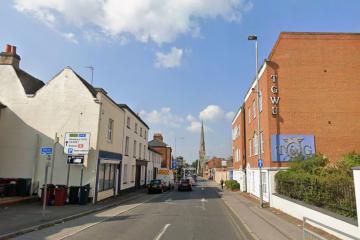
Despite being one way, Southampton Street is a busy road heading into the town centre that is passed by thousands of people who either drive, cycle, walk or get the bus.
Those who use it will have noticed the TGWU signage on the side of a three-storey brick building near the junction with Crown Street.
Although the lettering has been there for more than 30 years, it has not been judged to be ‘socially important’ enough to warrant conservation.
TGWU stands for the Transport and General Workers’ Union, which was once one of the largest trade unions in the world.
The union previously had offices in King’s Road from 1954 before moving to Southampton Street in 1989/1990.
The lettering is being discussed as it has been nominated as historically significant through Reading Borough Council’s local listing process.
Anyone can nominate a building to be locally listed.
If this status is granted, the existence and preservation of the building can become a planning consideration.
Arguing for the listing, the nominator stated: “In 1989, TGWU moved from premises on King’s to new premises on the ground and first floors of 89 Southampton Street.
“The opening and unveiling of a plaque took place in February 1990 by Ron Todd general secretary 1985-1992, and Mayor, Councillor Maureen Lockey.
“At some point, the TGWU lettering on the front was replaced by a T & G sign and a T&G sign added to the side of the building.
“In 2007, the TGWU merged with Amicus to form Unite.
“The T&G sign on the front of the building was removed sometime between September 2012 and July 2014, but the larger sign on the side and TGWU lettering remains and is worthy of protection in situ as a record of Reading’s trade union history.”
A decision on listing has to be made by the council’s planning applications committee.
The nomination has been assessed by Burcu Can Cetin, the council’s conservation officer, who has argued that the letters should not be listed.
Her report states: “Although the signage provides evidence of TGWU’s
presence in Reading, its relationship to the physical, social, and architectural aspects of Reading’s historic environment is limited.”
She also noted that the signage is a simple reproduction of the union’s nationwide branding, citing examples in Bristol and London, with the building in Bristol having a distinctive image of three apparently nude men holding a torch.
The logos for Transport and General Workers’ Union branding in Bristol, featuring the images of three men, and in London. (Image: Transport and General Workers’ Union Wikipedia page)
A decision on the nomination is due to be made by councillors on Wednesday, October 7.
After the union vacated, the building was eventually converted into the Ibex House serviced apartments, made up of six self-contained flats.
