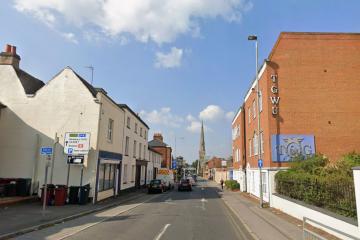
Southampton Street is used by thousands each day to get to the town centre.
‘TGWU lettering’ representing The Transport and General Workers’ Union has been there since 1989, when the union moved into new offices.
An application was submitted to put the lettering on Reading Borough Council’s list of locally important buildings and structures, which would protect it if a plan is ever submitted to demolish the building or remove the lettering.
The listing proposal was discussed at a meeting of the council’s planning applications committee.
Burcu Can Cetin, the council’s conservation officer, stated that it should not be listed as it does not meet listing criteria set out in the Local Plan.
Unique letters on building passed by thousands each day not deemed socially important
Members widely disagreed, arguing lettering should be preserved as a representation of Reading’s working class history.
Councillor Josh Williams (Green, Park) said: “I understand the 1990s feels like yesterday, to be honest, so I can understand it doesn’t have great age, but in another 50 years’ time this will have great age, and when it’s gone, it’s gone!”
Cllr Micky Leng (Labour, Whitley) said: “When I first saw this report come forward, I thought ‘yes, it’s here!’
“Then I read the recommendation, and my heart sank.
“I pass it on the bus when I catch the bus, but I always thought I’d like to see that not end up in a skip somewhere.
“It is significant because they are rare, as rare as a rocking horse.”
The TGWU name was replaced when it merged with Amicus to form the Unite union in 2007.
Ms Can Cetin had argued that TGWU lettering was maintained on Unite buildings across the country, including Bristol and London.
The logos for Transport and General Workers’ Union branding in Bristol, featuring the images of three men, and in London. (Image: Transport and General Workers’ Union Wikipedia page)
However, cllr Leng then pointed out the lettering has actually been removed from the Unite buildings in Bristol and London, therefore making the union brand a rarity.
He said: “They are, to use the Monty Python [phrase], gone, deceased.”
Cllr Leng therefore suggested that it should be put on the list instead.
Agreeing, cllr John Ennis (Labour, Southcote) said: “I was a shop steward for the TGWU for 20 years, and used both them buildings, and was a very proud member of a very very high amount of union membership for the TGWU workers in Reading and Oxford.
“TGWU was a huge part of Reading for a long time, we wouldn’t get rid of Huntley & Palmers, Suttons or Courage Brewery.”
He then mentioned how workers from Reading were involved in the General Strike of 1926 and went on to become active in the TGWU and the wider labour movement after that.
Following these points, Ms Can Cetin did concede that the TGWU is a part of the history of Reading and shouldn’t be lost.
During the meeting, no one voted for her initial proposal for the listing to be rejected.
Instead, councillors unanimously agreed to add the lettering to the list on October 7.
